If you have shopped for a sun umbrella on Amazon, you have seen the same three words on almost every listing: 100% UV protection. Nearly every parasol claims it. A 2024 study that measured 37 umbrellas against their UPF labels found that only 2% to 10% of UPF claims held up under independent testing, with 95% confidence — and every umbrella that carried a printed UPF number in that study was new and unworn, before any real-world wear could degrade the coating. Portable umbrellas were the worst offenders: 100% of the ones tested were labeled UPF50+, and only 20% actually measured that high.
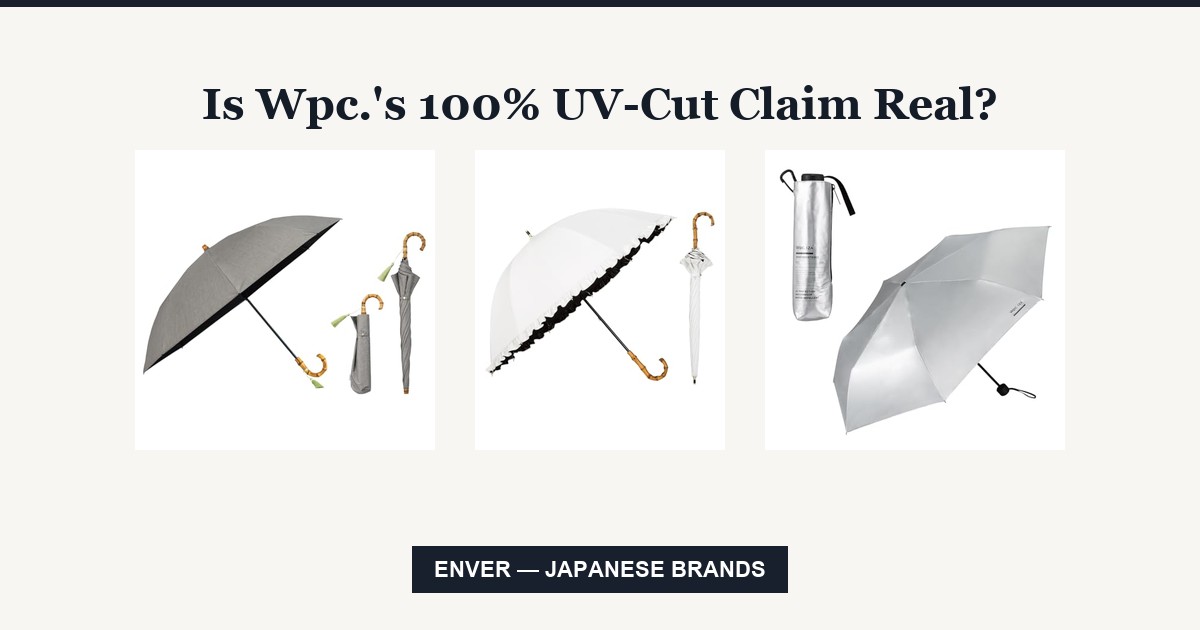
Wpc. is a Japanese parasol brand that shows up constantly in Amazon’s umbrella search results, under names like Wpc. IZA and Wpc. UVO, each one stamped with “100% shading rate, 100% UV cut, UPF50+.” The brand is close to unknown outside Japan — it has no entry from Wirecutter, Apartment Therapy, or any outlet that runs the kind of umbrella testing described above, only small importer storefronts and marketplace listings. So the question that matters isn’t just “is this a real Japanese company” — it’s the one the study above raises directly: is a 100% claim from a company nobody outside Japan has heard of any more trustworthy than the same claim from a brand nobody has heard of anywhere? The answer turns out to hinge on one difference: whether the number is tied to a named, checkable test method, or not.
Who actually makes Wpc. umbrellas
Wpc. is owned and sold by 株式会社ワールドパーティー (World Party Co., Ltd.), headquartered at 1-2-9 Abiko, Sumiyoshi-ku, Osaka. The company’s own page lists capital of
The corporate history is more tangled than a single “founded in” date suggests, and it is worth laying out plainly rather than smoothing over. Japan’s corporate number registry, searchable through the national corporate number database, lists corporate number 5010001240903 at this exact Osaka address. That specific legal entity was newly registered on December 18, 2023, under the name “WP Holdings Co., Ltd.” On December 11, 2024, it was renamed to 株式会社ワールドパーティー and absorbed a separate, older company that had been operating under the identical name in the same ward of Osaka — the entity that had actually been selling umbrellas. Two days later, the registered address moved from Otemachi in Tokyo to the current Osaka site.
Meanwhile, the brand’s own retail site states a founding year of September 1985 for the company, and the Amazon.co.jp listing for one of its parasols describes the Wpc. name itself as “born in 2004” as a domestic umbrella brand under the slogan “creating new possibilities,” on the same product listing. None of these three dates — 1985, 2004, 2023 — contradicts the others once you separate them: 1985 is when the original umbrella wholesaler was founded, 2004 is when the current brand name launched inside that company, and 2023–2024 is when a holding-company restructuring created a new legal entity that absorbed the old operating company and took its name. That is a normal pattern for a mid-size Japanese manufacturer going through a corporate reorganization, not a sign of a shell company. The point of checking it at all is that a US buyer has no way to run this search themselves — Japan’s corporate registry doesn’t return English results, and none of this appears on the Amazon listing.
Sold by vs. manufactured by
Design and brand ownership sit in Osaka. Manufacturing does not. Rakuten Ichiba’s own product filters, which sellers must declare accurately under Japanese labeling law, show current Wpc. umbrella listings with country of manufacture set to China; other Wpc. lines are produced in Cambodia. This is the ordinary split for a Japanese apparel-adjacent brand: the company that owns the brand, tests the fabric, and answers for defects is Japanese, while the factory that cuts and sews the umbrella is not. Neither fact cancels the other out, and a Wpc. product page never states it plainly — it has to be pulled from the manufacturing-country field sellers are required to fill in.
The more useful distinction for a US buyer is who is selling the umbrella, not who is sewing it. On Amazon.co.jp, Wpc. products are sold directly through “Visit the w.p.c Store,” the brand’s own registered storefront, and the brand field on that listing reads “w.p.c.” On Amazon.com, that is not guaranteed. Two current, separate US listings for Wpc.-line parasols both show Amazon’s structured brand field as “Generic” — Amazon’s placeholder for a listing where no brand has claimed the product page through Brand Registry — even though one of those same listings describes itself in its own bullet-point specs as “Brand: Wpc. (Japan).” The item text and the platform’s own brand-registry field disagree on the same page. “Generic” does not automatically mean counterfeit or unauthorized; it usually means a reseller or a parallel importer created the listing rather than the brand itself. But it does mean the seller behind that specific listing is not the same accountable party as the Osaka company whose capital, address, and registration you can check. Before buying, checking the brand field on the exact listing — not just the product title or bullet copy — takes ten seconds and tells you which one you are dealing with.
What “100% UV cut” and “100% shading rate” actually mean
This is where Wpc. separates itself from most of the generic parasols surrounding it in Amazon search results, and it is the actual answer to the reader’s question. Wpc.’s flagship line, UVO, states a shading rate of 100% and a UV cut rate of 100%, built from a five-layer laminated fabric structure. Those numbers are not marketing copy invented for the label — they map to two named, published Japanese Industrial Standards, each with a public test method a lab can run and a buyer can look up.
UV cut rate is measured under JIS L 1925, issued January 21, 2019, which puts a fabric sample in a spectrophotometer and irradiates it across the 290nm–400nm band — the UV-A and UV-B range that actually reaches skin — then calculates the shielding rate as 100 minus the average transmittance. Shading rate is measured under JIS L 1055, a standard originally written for blackout curtains, using either an illuminance box lit to 10,000–100,000 lux or a luminance meter, and grading fabric into three light-blocking classes, from Grade 3 (99.40%–99.80% blocked) up to Grade 1 (99.99% or higher). A parasol advertised as “100% shading” is being sold on a Grade 1 rating from a test method built for curtains and repurposed for umbrella fabric — a detail no listing explains, but one that is checkable by name.
The Amazon.co.jp listing for the automatic UVO parasol adds a qualifier that matters more than the headline number: “The listed shading rate, UV shielding, and UPF values are measurements of the state of the fabric. This does not indicate the performance of the umbrella itself. Areas other than UV-treated fabric, such as embroidery and sewing, [are not covered].” That sentence, sitting in the product description on the same listing, is the manufacturer stating outright that the 100% figure applies to the treated fabric panel, not to seams, stitching thread, or decorative trim — the exact gap the umbrella study above found most brands never disclose at all. The same listing also names the inspection body and date behind the specific unit tested: the Japan Textile Product Quality and Technology Center, with a certificate issued June 19, 2023. A named lab and a dated certificate is a materially different claim from an unattributed “UPF50+” printed on a hangtag with no test method behind it, which is what the PMC study found on the large majority of the umbrellas it checked.
What Japanese buyers say — including the reviews that aren’t five stars
The automatic-open UVO parasol carries 42 ratings on Amazon.co.jp at a 4.0-out-of-5 average: 51% five-star, 25% four-star, 10% three-star, 3% two-star, and 11% one-star. The praise is consistent across reviews — buyers describe a noticeably cooler feel under the canopy and reliable water repellency in sudden rain. The complaints cluster around one part of the product: the automatic open/close mechanism, not the UV fabric.
One verified one-star review, posted June 30, 2023, describes a unit that would not open at all: “After removing the band, pressing the automatic open/close button did not open it. It’s defective. The instructions say it can’t be opened manually, so it’s completely unusable. I’m returning it.” A three-star review from September 2, 2024 liked the design but flagged durability: “Light for an automatic, and I like the design. But it’s weak against wind. I’m worried about whether the frame will hold up in a strong gust.” A four-star review held back a star for the same reason — satisfied with light-blocking and ease of use, but noting “I don’t know about its durability, so four stars.” None of the negative reviews on this listing dispute the UV or shading performance itself; they are about the mechanical hinge that lets the umbrella open with one button press, which is a separate part from the treated fabric the JIS numbers describe.
What we verified and what we could not
Verified against primary sources: the corporate registration, capital, and address of the company behind the brand; the existence and test method of both JIS standards Wpc. cites; the exact disclosure language on an official listing limiting the 100% figures to treated fabric; the inspection body and certificate date for one specific model; the manufacturing-country declaration of China for current listings; and the brand-field discrepancy between a Wpc.-branded and a Generic-branded listing on Amazon.com. Not verified: whether every Wpc. SKU sold on Amazon.com carries the same JIS certificate as the JP-market unit referenced here, since US listings do not reproduce the inspection date or lab name shown on the Japanese listing — a buyer working from the US-market page alone cannot confirm which specific test certificate applies to the exact unit they receive.
Who this is for
If you want a parasol whose UV-blocking claim is tied to a named test method rather than an unattributed number on a hangtag, buy directly from Wpc.’s own storefront on Amazon.co.jp or wpc-store.com rather than a “Generic”-branded Amazon.com listing, since the US listings checked here do not carry the same accountable seller or reproduce the inspection date shown on the Japanese page — and treat the 100% figure as a rating of the fabric panel, not of the seams or trim. If wind resistance matters more to you than UV testing rigor — for a beach, a stroller, or daily commuting in gusty conditions — the reviews above point at the automatic hinge as the weak point to check, and a manual (non-automatic) folding model removes that specific failure point entirely. If you only need light shade for an occasional errand and don’t care whether the UV number is independently checkable, the study cited above shows most competing umbrellas make the same claim without any test behind it at all — so paying more for Wpc. buys you a checkable number, not a unique amount of shade.
Sources and verification
Every factual claim in this article is listed below with the source it came from. Each source is linked — you can check any figure yourself.
| Claim | Source |
|---|---|
| Corporate number 5010001240903 registers 株式会社ワールドパーティー at 1-2-9 Abiko, Sumiyoshi-ku, Osaka | 法人番号データベース |
| That legal entity was newly registered 2023-12-18 as WP Holdings Co., Ltd., renamed to 株式会社ワールドパーティー and absorbed the prior operating company on 2024-12-11 | 法人番号データベース |
| The company states capital of ¥110,000,000 and representative director Tomio Tomita | 会社概要 |
| Wpc.’s retail site states the company was founded in September 1985 | Wpc.公式ストア 会社概要 |
| The Wpc. brand name itself launched in 2004 | Amazon.co.jp 商品ページ |
| The UVO line states a 100% shading rate and 100% UV cut rate from a five-layer laminated fabric | Wpc. UVO製品ページ |
| JIS L 1925 (issued 2019-01-21) measures UV shielding rate by spectrophotometer across 290nm-400nm | Kaken Test Center |
| JIS L 1055, originally a curtain-blackout standard, grades shading performance into three classes up to Grade 1 (99.99%+) | Kaken Test Center |
| The Amazon.co.jp listing states shading/UV/UPF figures measure the fabric only, not the whole umbrella, and exclude embroidery and sewing | Amazon.co.jp 商品ページ |
| The tested unit’s certificate was issued by the Japan Textile Product Quality and Technology Center on 2023-06-19 | Amazon.co.jp 商品ページ |
| Current Wpc. umbrella listings on Rakuten declare country of manufacture as China | 楽天市場検索 |
| This listing has 42 ratings averaging 4.0/5, with 11% one-star | Amazon.co.jp 商品ページ |
| A verified one-star review (2023-06-30) reports the automatic open mechanism failed and the unit was returned as defective | Amazon.co.jp カスタマーレビュー |
| A verified three-star review (2024-09-02) flags concern about wind durability | Amazon.co.jp カスタマーレビュー |
| An academic evaluation of 37 umbrellas found only 2%-10% of printed UPF claims verified under independent testing (95% CI) | PMC study |
| One current Amazon.com Wpc. umbrella listing shows Amazon’s structured brand field as ‘Generic’ while its own bullet-point item description separately states ‘Brand: Wpc. (Japan)’ | Amazon.com listing |
| A second, unrelated current Amazon.com listing for a Wpc.-line parasol also shows the brand field as ‘Generic’ | Amazon.com listing |
Primary sources
Each link below was retrieved while writing this article. A dated snapshot of every page is kept on file.
- 株式会社ワールドパーティー 会社概要 — www.worldparty.co.jp
- Wpc.公式オンラインストア 会社概要 — www.wpc-store.com
- Wpc. UVO製品ページ(遷光率・UVカット率) — www.wpc-store.com
- 法人番号データベース 5010001240903 — houjin.jp
- Amazon.co.jp 商品ページ(選光オートマティックパラソル・レビュー) — www.amazon.co.jp
- Kaken Test Center — JIS L 1925 紫外線遮蔽性 — www.kaken.or.jp
- Kaken Test Center — JIS L 1055 遷光性試験 — www.kaken.or.jp
- 楽天市場検索(Wpc. 日傘・原産国/製造国中国) — search.rakuten.co.jp
- PMC — Evaluation of Ultraviolet Protection Claims Made by Umbrellas — pmc.ncbi.nlm.nih.gov
- Amazon.com — Wpc. folding umbrella listing (brand field vs. item text) — www.amazon.com
- Amazon.com — second Wpc.-line listing (brand field: Generic) — www.amazon.com
comment comment